Protest against setting up of cement factory in highly populated area near BIA
· Sri Lanka
What began quietly as a single-storey tourist hotel, on the edge of Katunayake-Seeduwa has, five years later, morphed into a looming five-storey cement factory and with it, a storm of fear, anger and unanswered questions.
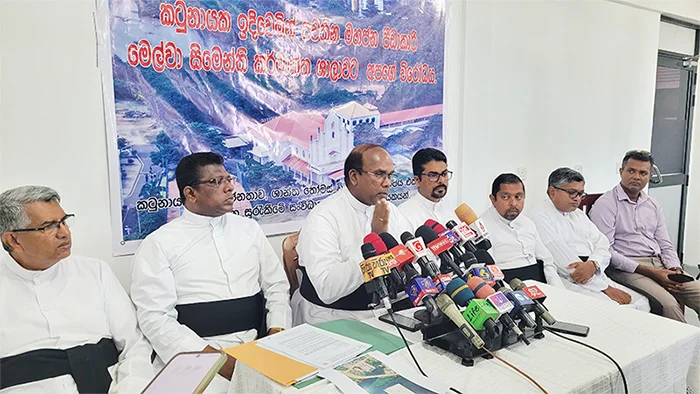
At a media briefing held on 19 September at St. Thomas International School, Seeduwa, the community finally found its voice. The gathering included priests, school principals, environmental defenders, and parents whose children study within a few hundred metres of the site.
The briefing was led by Rev. Fr. Jude Chrishantha Fernando, Director of National and Archdiocesan Catholic Social Communications, Rev. Fr. Nilantha Heshan, Director of the Archdiocesan Sethsarana Institute, Dinusha Nanayakkara, Convener of the Archdiocesan Committee for the Protection of Muthurajawela, and Attorney-at-Law Ms. Isuri Rodrigo.
Their message was clear: This is not a campaign against development.
“We Are Not Against Cement. We Are Against Deception.”
“Cement is an essential raw material for the country. We have no opposition to any such factory or production plant,” they told the media. “But what we cannot agree to is a project of this magnitude, in this location, without any proper environmental assessment.”
The speakers alleged a textbook case of deception, obtaining approvals for a low-impact tourist hotel, in one of the most densely populated educational zones in the Katunayake-Seeduwa Municipal Council area, and then transforming it into a heavy industrial plant.
“In an area where thousands of schoolchildren study, to show one thing on paper and build another is a highly fraudulent procedure. It is clear that the real environmental damage and the truth have been hidden from the people,” they said.
With the sea and lagoon winds that sweep across Seeduwa, experts fear these fine particles will not stay confined to the factory walls. They will drift across classrooms, homes, and the Katunayake Free Trade Zone, where thousands of workers, representing all 25 districts of Sri Lanka, work every day.
“The risk is not local. It is national. We are talking about a future generation of children with respiratory illnesses, and workers developing chronic breathing disorders,” one speaker warned.
Rev. Fr. Jude Chrishantha Fernando, Director of National & Archdiocesan Catholic Social Communications, responding to journalists
Then there is the proximity that defies logic, just 500 metres from the Bandaranaike International Airport.
The panel presented a scientific concern that has aviation experts worried: a significant drop in air quality around the airport and its runway, and the severe risk to highly sensitive aircraft engines when they ingest air mixed with cement dust. What is at stake, they argued, is not just health but the economy itself.
“When you weigh it deeply, the economic contribution of an international airport is far higher than that of a cement factory. If international airlines start to avoid Katunayake due to safety and air quality concerns, it will be a fatal blow to our country’s economy,” they emphasised.
A few minutes away lies another victim the Negombo Lagoon and the Muthurajawela wetlands, Sri Lanka’s largest and most sensitive coastal ecosystem.
The panel warned that cement dust settling on the mangrove system could degrade water quality, disrupt the delicate salinity balance, and directly interfere with fish breeding grounds. For the fishing communities of Negombo, whose lives depend on the lagoon, this is an existential threat.
“The lagoon is a nursery. If its water quality drops, fish will not breed. If fish do not breed, an entire fishing community collapses,” they said.
The speakers alleged that while the developers claim to have approvals from various state institutions, many of the mandatory clearances, particularly comprehensive Environmental Impact Assessments and feasibility reports, have not been obtained.
They stressed they are not calling for an end to investment, but for it to be done right.
“We have no objection to this factory being started in another suitable location where it will not cause these environmental impacts, based on proper feasibility and assessment reports. Stop this construction here and move it,” was the unanimous demand.
The appeal has now been directed again to the President, the government, and all responsible state institutions and officials.
As the briefing ended, one image lingered — a school playground, a lagoon, and a towering cement structure rising between them. It is a scary picture for the people of Seeduwa; they asks a simple question: What price are we willing to pay for development that doesn’t breathe?
Source: The Island