Illusion of recovery: Three fault lines threatening Sri Lanka’s future
· Sri Lanka
The official narrative surrounding Sri Lanka’s economic recovery is optimistic and up-beat. President Anura Kumara Dissanayake has repeatedly assured the public that the nation, which faced catastrophic bankruptcy in 2022, is finally entering “safe waters.” This political optimism is backed by data from the Central Bank of Sri Lanka (CBSL [1]), which projects an annual economic growth rate of approximately 5%, bolstered by the country’s recent structural upgrade to “middle-income” status. On paper, the macroeconomic indicators suggest a remarkable turnaround.
However, this statistics-based triumph masks a much darker, systemic reality. Below the surface of stabilised foreign reserves and GDP growth lie at least three dystopian structural fault lines: massive capital flight, an unprecedented brain drain, and a severe demographic inversion. Together, these factors form a quiet crisis that threatens to rapidly destabilise Sri Lanka, rendering its current economic recovery fragile and potentially unsustainable. In addition, we must factor in the devastating effects of climate change and sea-level rise that will play out unabated.
Independent economists note that “safe waters” at the state level have yet to translate to ordinary citizens. The 5% growth and upgraded income status have been achieved through aggressive taxation (VAT hikes) and high energy costs, meaning that while the state’s coffers are recovering, real household poverty remains painfully high and becoming worse, while the rich-poor gap is widening.
Fault Line 1: Corporate betrayal and unchecked capital flight
While the government actively pursues high-profile political figures for historical financial crimes, the most devastating drainage of Sri Lanka’s wealth is happening legally and semi-legally through the corporate elite. Capital flight has severely hollowed out the state’s financial foundation.
Research from global watchdogs like Global Financial Integrity (GFI) reveals that trade mis-invoicing, i.e., the practice of under-invoicing exports and over-invoicing imports to illicitly park profits in offshore accounts, has stripped Sri Lanka of billions of dollars annually (GFI, 2024, [2]).
This is compounded by massive migration within the garment and manufacturing sectors. Facing exorbitant domestic energy tariffs and steep Value Added Tax (VAT) hikes, major conglomerates have steadily relocated production capacities or established vital subsidiaries in more cost-effective hubs, including Kenya, Jordan, and Oman (National Chamber of Exporters, 2025, [3]).
The state’s recent investigation into over $1 billion in “phantom imports”, where advance payments were sent abroad via Telegraphic Transfers without any goods ever entering the country, demonstrates that the private sector continues to drain the country of the very foreign exchange required to sustain its recovery.
While big capital has systematically flown out of the country, exploiting critical financial loopholes intentionally created during the Yahapalanaya (Maithripala-Ranil) era, successive administrations have persistently attempted to deflect blame for Sri Lanka’s financial collapse onto external or secondary factors. A glaring example of this misdirection occurred when major international media outlets, most notably The New York Times, claimed that Chinese infrastructure loans and “debt-trap diplomacy” were primarily responsible for the country’s economic insolvency—a narrative that independent economic data has since thoroughly debunked. Similarly, a favourite rhetorical theme among all political leaders is that bribery and state-level corruption by their rivals were the singular drivers of the crisis.
Neither geopolitical debt nor political corruption has been as structurally catastrophic as the quiet, massive flight of private investment capital. This exodus was critically accelerated when the Yahapalanaya administration, under Finance Minister Ravi Karunanayake, systematically dismantled the nation’s regulatory guardrails by repealing the robust Exchange Control Act No. 24 of 1953 and replacing it with the highly liberalised Foreign Exchange Act No. 12 of 2017. This legislative shift effectively decriminalised unauthorised foreign currency retention, removed stringent tracking mechanisms on export proceeds, and opened the floodgates for legal and semi-legal capital flight in the critical years leading up to the Gotabaya Rajapaksa administration and its financial collapse. By prioritising the convenience of the corporate elite over national reserve security, these policy manoeuvers permanently starved Sri Lanka of vital foreign liquidity at the exact moment it was in dire need of retaining and attracting stable investment capital.
The removal of these Exchange control and Foreign exchange acts would seem entirely destructive to Sri Lanka in hindsight today. However, both Ranil Wickremesinghe and Ravi Karunanayake are avowed neo-liberal ideologues who would have viewed the removal of those legislations as part of their idea of full free trade and over-arching globalisation. However, perhaps unknown to them, globalisation had hollowed out the Western manufacturing base; nationalist populism and tea-party politics had already raised its head in the West. Finally, the Covid epidemic drew the curtain on the era of neoliberalism, with even the more ardent “Ayn Randyan” opponent of state intervention conceding to massive state intervention to face Covid.
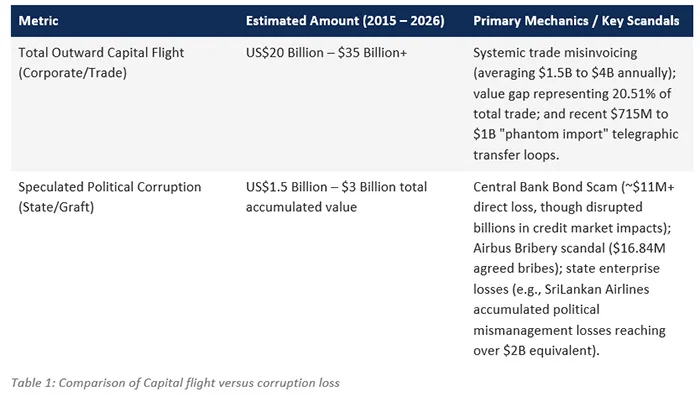
To evaluate which factor has a greater structural impact on Sri Lanka’s economic stability, we must look at data from international watchdog groups like Global Financial Integrity (GFI) alongside localized corruption cases since the beginning of the Sirisena-Wickremesinghe administration (2015) up to 2026. We do this in Table 1.
MetricEstimated Amount (2015 – 2026)Primary Mechanics / Key Scandals
Total Outward Capital Flight (Corporate/Trade)US$20 Billion – $35 Billion+Systemic trade misinvoicing (averaging $1.5B to $4B annually); value gap representing 20.51% of total trade; and recent $715M to $1B “phantom import” telegraphic transfer loops.
Speculated Political Corruption (State/Graft)US$1.5 Billion – $3 Billion total accumulated valueCentral Bank Bond Scam (~$11M+ direct loss, though disrupted billions in credit market impacts); Airbus Bribery scandal ($16.84M agreed bribes); state enterprise losses (e.g., SriLankan Airlines accumulated political mismanagement losses reaching over $2B equivalent).
Table 1: Comparison of Capital flight versus corruption loss
The data reveals that corporate capital flight dwarfs political corruption by an order of magnitude, making it the far more critical structural threat to the country’s economic baseline. Ultimately, while the media and politicians focus on the theatre of political arrests, the quiet, systemic white-collar flight of capital by the country’s “Big Tycoons” acts as a far more lethal haemorrhage dragging Sri Lanka back down into financial collapse.
Fault Line 2: The catastrophic brain drain
An economy cannot expand at a sustained 5% rate without human capital. Yet, Sri Lanka is currently experiencing an unprecedented exodus of its professional class. The economic collapse of 2022, followed by the subsequent imposition of heavy income taxes, soaring inflation, and a diminished quality of life, triggered a massive wave of migration.
Unlike the labour migration of previous decades, which consisted primarily of low-skilled workers sending back remittances, the current “brain drain” consists of the nation’s intellectual bedrock: doctors, software engineers, university professors, accountants, and aviation technicians. According to data from the Sri Lanka Bureau of Foreign Employment (SLBFE, [4]), record numbers of professionals have left the island for Europe, the Middle East, and Australia. The impact on critical infrastructure is already dystopian. Government hospitals frequently report a severe shortage of specialized consultants and anesthetists, while the domestic tech sector faces a crippling deficit of senior developers. Sri Lanka is effectively funding the free education of its youth, only for foreign economies to reap the productivity and tax revenues of those graduates.
The articles by (i) Hasini Lecamwasam entitled “The emptying university: why are academics leaving? (Island, 15th September 2026) [5], and Prof. Amarasiri de Silva’s article entitled Sri Lanka’s university crisis: Brain drain and union action demand urgent reform (Island, 14th September 2026) [6], specifically expose the dire situation faced by the existing 17 Sri Lankan Universities today, even though President AKD hopes to open 50 more universities shortly. Realistically, the available resources completely rule out the President’s proposal. Sri Lanka spends roughly 1.5% to 2% of its Gross Domestic Product on public education, one of the lowest in the world. Meanwhile many degree-certificate granting institutions (“private universities”) that have commodified higher education have sprung up to fill the need.
In any case, as we explain in the next section, the population is Sri Lanka has peaked, and its population pyramid has inverted, with fewer youth than older adults. There will be closure of schools as rural areas become hollowed out, and decreased enrolment in regional universities.
Fault Line 3: Demographic Inversion and the Aging Crisis
Perhaps, the most irreversible threat to Sri Lanka’s long-term stability is its rapidly changing demographic profile. Sri Lanka is currently undergoing a severe population inversion, transitioning into an aging society at a much faster rate than its regional peers.
Due to a combination of declining fertility rates, increased life expectancy, and the mass migration of reproductive-age young professionals, the demographic pyramid has flipped. For the first time in modern history, the population of elderly citizens (aged 60 and above) is growing faster than the younger demographic required to support them. According to United Nations and World Bank demographic assessments, Sri Lanka is projected to have one of the oldest populations in South Asia within the coming decade (World Bank, 2025 [7]).
This inversion creates a devastating double-bind for the state:
· Shrinking Tax Base: As young people leave or age out of the workforce, the pool of taxable income contracts.
The state faces ballooning expenditure requirements for geriatric healthcare, social safety nets, and pensions.
· The flight of businesses seeking cheap labour:
As the young workforce shrinks, manufacturing and businesses leave the country to relocate in other countries where labour is cheap. This flight of capital was discussed by us as “fault line number 1”.
Unlike Western nations that grew wealthy before they grew old, Sri Lanka is facing a demographic crisis while still trying to climb out of bankruptcy. According to recent data from the Sri Lankan Census and demographic researchers (De Silva 2025 [8]), Sri Lanka’s population peaked at 22.1 million in 2022 and has already entered a structural contraction. Sri Lanka’s total Fertility Rate (TFR) has collapsed to an ultra-low 1.3 children per woman—a rate lower than many highly developed Western nations, and well below the 2.1 needed for sustaining the population from extinction.
Sri Lanka had a rapid population increase after WWII, thanks to its adoption of modern agriculture (Green Revolution), control of infectious diseases such as malaria. However, Sri Lanka could not profit from the potential of its demographic bulge as a labour force. It moved towards a sluggish Marxist economy that sought state control and dismantled its plantation sector, placed draconian control over foreign exchange and investments.
Right after Independence, Sri Lanka prioritised universal free education and extensive reproductive health literacy. Meanwhile, free education led to exceptionally high female literacy rates early on. Historically, whenever female education rises, birth rates plummet—even if the nation’s GDP per capita remains relatively low.
From 1956 to 1977, Sri Lanka implemented economic policies directed towards increasing state control every aspect of the economy with foreign exchange controls. A stagnant economy led to youth uprisings that took the form of intra- and inter-ethnic conflicts that took a toll of youth populations. While an open economy was heralded in 1977 youth uprisings had already established themselves. Even children were mercilessly recruited as child soldiers by the LTTE and forced into an unwinnable conflict where about 7% of the population in the North and East (Tamils) were pitted against the government that drew strength from some 80% (Sinhalese and Muslims) of the remaining population.
Furthermore, many in the local work pool found it more lucrative to go to the Gulf countries as migrant workers, depleting the local availability of labour.
When Sri Lanka opened its economy in 1977 it succeeded in using its cheap labour pool to establish a world-class industrial base in clothes and similar industries. However, the rate of population growth slackened with increased literacy and today the population pyramid has completely inverted, with its labour pool shrinking and implying a demographic nightmare of ethnic extinction for Sri Lankans.
Countries such as Sri Lanka that do not have the financial power of countries such as South Korea or Japan (which are able to resort to robotics and AI agents) may have to turn to sperm and ova banks, in-vitro fertilisation, as well as state sponsored group parenting to sustain its population or simply face extinction. The need for such technologies was anticipated by scientists such as J. B. S. Haldane in 1924 [9], with corresponding themes were built into fictional works such as Aldous Huxley’s “Brave New World”. (To be concluded)
Source: The Island