In Memory of Dr Upatissa Pethiyagoda
· Sri Lanka
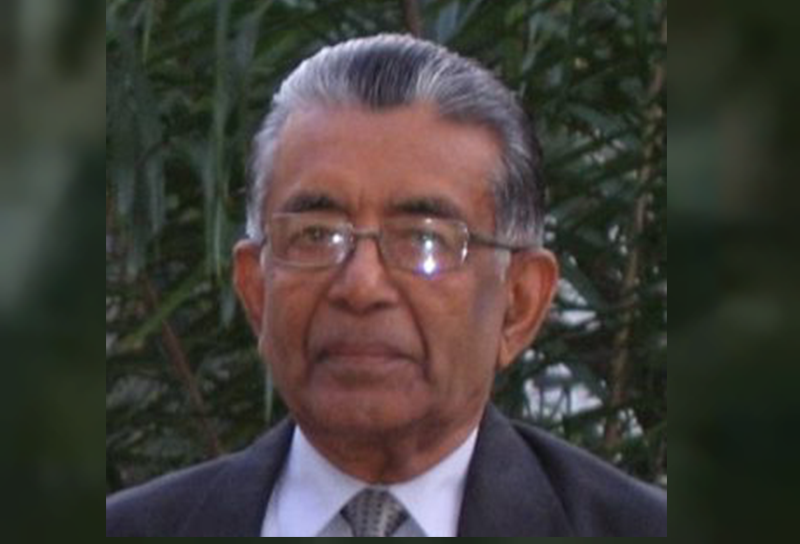
It is with a deep sense of sadness that I record the passing of Dr Upatissa Pethiyagoda, who died on 27 August 2026 at the age of 94. To many, he was a distinguished scientist, accomplished administrator, diplomat and public intellectual. To me, he was much more than that.
Dr Pethiyagoda was a proud product of Trinity College, Kandy. At a time when a first class in Botany was a rarity, he obtained one and subsequently pursued postgraduate studies in London. His scientific career reflected not only his knowledge but, more importantly, an enquiring and restless mind that was never satisfied with simply accepting what was known.
In the 1970s, he headed the Plant Physiology Department of the Tea Research Institute of Sri Lanka. He was part of a formidable team of scientists that included Drs R L de Silva, R L Wickramasinghe, P Sivapalan, Tilak Wettasinghe and W Danthanarayana. They were scientists who contributed enormously to the development of the tea industry in Sri Lanka, and Dr Pethiyagoda stood comfortably among them.
In 1978, he moved to the Coconut Research Institute as its Director. It was there that I had the privilege of working with him. Those years left a lasting impression on me.
Dr Pethiyagoda was, in every sense, a complete scientist. Although his formal specialisation was plant physiology, he was remarkably comfortable discussing almost anything scientific. What distinguished him was his curiosity. He questioned the science behind the ordinary things that most of us simply accepted. I remember his asking questions such as, why is an orange green in Sri Lanka? It was typical of him: an apparently simple observation would lead him to ask what lay behind it.
After his tenure at the CRI, he undertook an FAO assignment in the Middle East, working on the improvement of date palms. There he was exposed to agriculture under conditions of severe water scarcity. He pursued this further during a visit to Israel, learning about agronomic practices suited to such environments. Later, when he worked with the Mahaweli Authority, he was able to translate that knowledge into practice, introducing high-value horticultural crops to Systems B and C.
What impressed me was not merely that he acquired knowledge, but that he connected knowledge from one context to another and turned it into practical solutions. His enquiring mind and analytical ability enabled him to do this with remarkable effectiveness.
He was equally impressive as a communicator. Dr Pethiyagoda was an eloquent speaker, whether he was talking about science, agriculture, public policy or the everyday affairs of our country. His speeches were often laced with wit, humour and the occasional tongue-in-cheek remark. But beneath the humour was a very serious mind. He was forthright in his opinions and, importantly, he was not afraid to express them, whatever the possible repercussions.
His contributions to the media demonstrated this courage.
Writing about the travel to London by a former President, he observed:
“Where a person enjoys immunity by virtue of his position, this carries a reciprocal obligation to exercise an abundance of exemplary behaviour. In effect, immunity is best exercised, when the need to invoke it, is never allowed to arise.”
[Immunity Does Not Confer Impunity – Colombo Telegraph]
That was quintessential Pethiyagoda—precise, pointed and impossible to misunderstand.
He was equally outspoken about the government’s decision to ban inorganic fertiliser with ‘immediate effect’. He was deeply distressed by what he believed would be the consequences for farmers, particularly the poorer farming community. He would speak about it almost every day, driven not by political considerations but by his conviction that science and evidence had been disregarded.
In one of his writings on the subject, he remarked:
“What the ‘Vipathmaga’ caper taught us was that advice of sundry ‘Experts’ can be disastrous. Professors of Surgery, clergymen and Pediatricians are not the best equipped to advise on fertilisers, as much as a Soil Scientist should not prescribe treatment for a sick child.’ [Some Lessons That Can Be Learned Even From Disasters – Colombo Telegraph]
And in another article, his frustration was summed up in the memorable words:
“Stupidity, like History, has a way of repeating itself.”
These were not simply provocative statements. They reflected a scientist who believed deeply that public decisions, particularly those affecting agriculture and the livelihoods of farmers, should be based on evidence and sound scientific advice.
Perhaps, what I will remember most about Dr Pethiyagoda is that his curiosity survived almost to the very end of his life.
Very recently, he was still asking questions and pursuing ideas. He was interested in the possible genetic differences between the waraka and wela varieties of jak, because he wondered whether the wela variety might have commercial potential for cellulose extraction. He was disappointed that he could not find relevant scientific literature in Sri Lanka. More than the particular subject, what struck me was that at 94 he was still thinking about a scientific question, looking for evidence and wondering whether an apparently ordinary resource could have an important national application. He lamented the lack of interest among scientists and academics in such questions of national importance. That concern, too, was very much part of who he was.
Dr Pethiyagoda also served as President of the National Academy of Sciences, Sri Lanka. Unfortunately, he was unable to complete his term because he was appointed Ambassador to Italy, with representation at the Food and Agriculture Organization in Rome. Even in that role, he remained very much the scientist. I understand that he made a significant contribution to FAO discussions. As Ambassador, he also had the unenviable task of entertaining Sri Lankan Ministers of Agriculture who attended FAO sessions. I know from my own conversations with him that those informal dinners were not merely social occasions. He would discuss agricultural issues with the Ministers, and I have little doubt that his views—and the force with which he expressed them—sometimes influenced their thinking.
Looking back, what I admired most about Dr Pethiyagoda was not any particular position he held or any particular achievement. It was the way he thought.
And he was willing to say what he believed to be true.
He also demonstrated that science should not remain confined to laboratories, research papers or academic institutions. For him, science was a way of looking at the world and, ultimately, a means of improving the lives of people.
It is perhaps ironic that, only a few months ago, he wrote about “The Cost of Dying”, as distinct from the “Cost of Living”. In that article, he reflected on the manner in which our mortal remains should be disposed of, observing: “I am in two minds regarding the manner in which the mortal remains are disposed of, ‘according to the will of the deceased’. But with the cessation of the breath, ownership or tenancy ceases.” Even in contemplating death, he brought his characteristic questioning mind to the subject. What particularly caught my attention, however, was his explanation of the Buddhist practice of holding dânes (almsgivings) for monks of the local temple in the seventh day and third month following a death. I had never really thought about the significance of this practice before. That, too, was typical of Dr Pethiyagoda: he could take something that we had accepted as ordinary and familiar and make us stop, think and see it differently.
His passing has created a colossal vacuum in Sri Lanka’s scientific community. People of his intellectual breadth, curiosity, courage and independence are rare. We may not always have agreed with everything he said, but we could never doubt that he had thought deeply about it and that he had the courage of his convictions.
For those of us who had the privilege of knowing him, there is sadness in his passing. But there is also gratitude—for having known such an extraordinary mind, for having learnt from him, and for having witnessed at close quarters his unwavering commitment to science and to the development of our country.
I shall remember Dr Pethiyagoda with great affection and immense respect.
Past President, National Academy of Sciences of Sri Lanka.
Source: The Island