Chinese-made cameras banned from government buildings show up in EVs
· Australia
Four Corners takes a Leapmotor for a drive around Canberra. (Four Corners: Ron Foley)
Just a year after hundreds of Chinese CCTV cameras were removed from federal government buildings over surveillance fears, cameras from the same company were back in Australia via a new brand of electric vehicle.
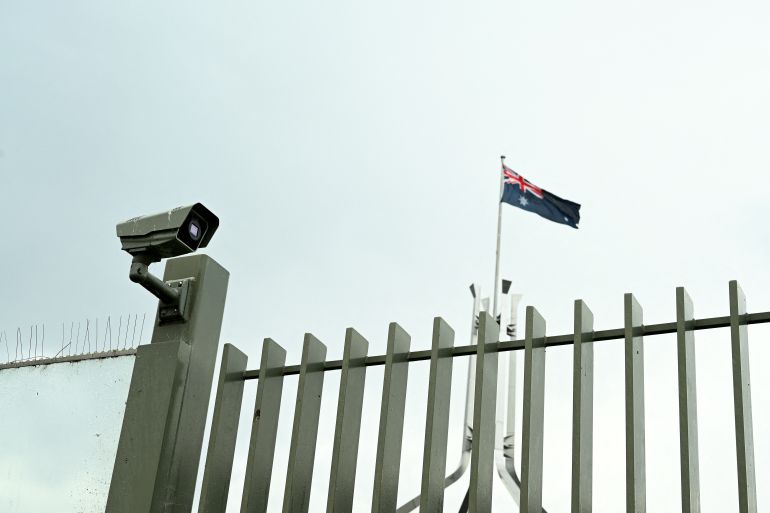
The removal of cameras made by Dahua Technology from federal buildings and defence sites generated plenty of headlines in 2023.
Less well-known is that as the surveillance company was being sanctioned around the world, it had pivoted to making cars.
The brand Leapmotor came to Australia in 2024, competing as one of the most affordable EVs in the market.
Another selling point was its technology, including a suite of cameras.
In the Leapmotor C10 there are six cameras, providing a 360-degree view of the car's surrounds and interior.
Some of these cameras are made by Dahua, yet there's nothing to stop the car being driven around some Defence sites or parked nearby.
Leapmotor's cars, like many EVs, have cameras which take in all their surroundings. (Four Corners)
Alastair MacGibbon, a former national cybersecurity adviser, said the microphones and cameras on an EV and some connected cars made them an ideal surveillance device.
He said an EV parked strategically near a government building could record when staff enter and exit and map the times people work.
"You can even determine when something important was happening based on changed patterns of employees," he said.
"Are there people that staff the watch office that are suddenly turning up at a time that means there's a crisis happening somewhere, or that the government is scaling up to do something?
"[It] establishes a mesh of video and electronic knowledge that is granular and when it's taken in totality is almost a near perfect real-time picture of Australia."
Alastair MacGibbon says Chinese-connected vehicles should be banned from military bases. (Four Corners: Ron Foley)
One day in August, Four Corners visited a public car park in Canberra which sits between the headquarters of ASIO, the Department of Defence and the Australian Signals Directorate (Australia's digital spy agency).
It contained 22 EVs — almost half of which were Chinese brands.
Fears of Chinese EVs being used as real-time surveillance devices have seen them banned from military sites overseas.
Last year in the UK, Chinese EVs and even those with Chinese components were banned from some sensitive sites and training bases.
In one case the military demanded they park more than 3 kilometres away.
Home Affairs Minister Tony Burke says Australia has some restrictions in place.
"I know of examples of people driving in with a different sort of connected vehicle and being told to have to park a long distance away," he said.
"So, the fact that you don't have the blanket ban [in Australia] doesn't mean you don't have a whole lot of precautions that are taking place."
The Department of Defence declined to say what restrictions were in place for connected vehicles.
Like Britain, China is wary of foreign EVs, particularly those owned by its strategic rivals.
In 2021 China banned Teslas, even those made at a plant in Shanghai, from political enclaves and some defence sites.
"I think this is one of the most telling data points that we should pay attention to," said opposition Defence spokesman James Paterson.
"If [China] think that's a risk in their country, then how should we feel about products they make and run here?"
Four Corners took a Leapmotor for a drive around Canberra.
We drove the car through the Royal Military College, Duntroon, past ASIO's headquarters and around the Russell Defence precinct.
Four Corners drives a Leapmotor to Royal Military College, Duntroon. (Four Corners: Ron Foley)
"When it comes to Chinese-connected vehicles, they should be banned from any military base, any intelligence facility, or any other sort of sensitive site and critical infrastructure," Mr MacGibbon said.
Senator Paterson, a former chair of the parliamentary committee on security and intelligence, said security agencies were so worried about Dahua cameras they even removed those not connected to the internet.
"It's extraordinary to me that we've ripped out [many] Dahua cameras from defence bases … but we've allowed that same technology in a connected vehicle to drive around those bases with all their cameras, all their sensors, all their data collection."
Leapmotor, which has three models for sale in Australia, has previously said its ambition was to be the "Huawei of the automotive world".
According to documents filed with the Hong Kong Stock Exchange, Leapmotor has an ongoing procurement contract with a Dahua subsidiary which agreed to supply cameras, sensors and radars to the car company.
Four Corners purchased a Leapmotor rear camera, which had the Dahua identifier (DH) as part of its labelling.
A Leapmotor camera. (Four Corners: Nick Wiggins)
While all connected vehicles pose a risk, Chinese EVs are viewed as more risky given Beijing's record of surveillance and hacking abroad.
In additions to this, its national security laws can compel Chinese companies to co-operate with authorities if requested.
"I think most people would recognise that it's a surveillance state and … it's shown its interest in large-scale electronic surveillance, not just inside China, but out," Mr MacGibbon said.
"What we're really talking about here is a national security issue caused by the aggregate number, hundreds of thousands of these vehicles, and soon to be the dominant type of vehicle sold in Australia."
A year after its cameras were removed, Dahua began selling Leapmotor EVs in Australia. (Four Corners: Ron Foley)
The modern range of EVs are driven by software, which is remotely controlled and updated.
The concern is that this software can be used to turn on microphones or cameras in a car, without the knowledge of the owner.
"[China] doesn't need to hack these vehicles to make them into a listening device or a surveillance device … it's a feature of the vehicle," Mr MacGibbon said.
Leapmotor did not respond to questions from Four Corners.
Watch Four Corners' full investigation, Asleep at the Wheel, tonight from 8:30 on ABC TV and ABC iview.
Source: ABC News - Top Stories