Al Maktoum International accelerates toward world's biggest airport status
· United Arab Emirates
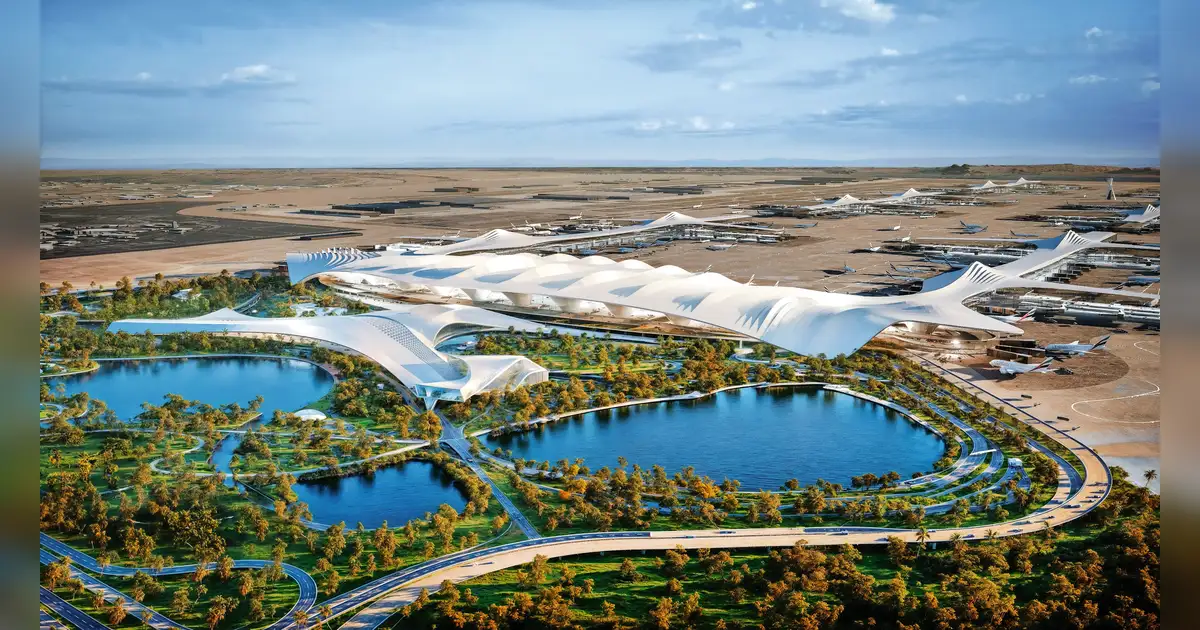
Al Maktoum International Airport is poised to become the world's largest aviation hub, with Dubai World Central (DWC) confirming that its second runway will become operational next year as scheduled. The milestone is expected to boost the airport's annual passenger handling capacity to 150 million during the first phase of the mega-expansion project, which is due to open in 2032.
The $35 billion Al Maktoum International Airport project, currently operating on a smaller scale, will feature five runways and have the capacity to handle up to 260 million passengers annually upon full completion. The airport is designed to provide the additional capacity required as Dubai International Airport (DXB) approaches its operational limits in the coming years.
Dubai Airports CEO Paul Griffiths said development work at Al Maktoum International Airport is progressing at full speed and remains on schedule, with the first phase expected to become operational at the beginning of the next decade. He noted that the availability of two runways from 2027 will help increase annual passenger capacity to 150 million within the next five years.
"The third and fourth runways will be added as terminal capacity expands, while the fifth runway will serve as a contingency facility when one of the others is out of service," Griffiths said during a recent media briefing in Dubai.
Flydubai, which is expanding its fleet to more than 100 aircraft, will be among the first airlines to transfer part of its operations to Al Maktoum International Airport. The carrier is likely to begin the transition next year, with the move taking place in phases.
Both Emirates and flydubai are expected to utilise Al Maktoum International's growing capacity as DXB nears saturation, while other airlines are expected to relocate at a later stage.
A queue-free passenger journey, rail-based processing and advanced baggage handling systems remain central to the future operating vision being developed for DWC. Facial recognition technology, supported by ceiling and wall-mounted cameras, will identify passengers and link them to their respective flights.
Dubai Airports is effectively "deconstructing" the traditional travel experience, enabling passengers to simply purchase a ticket without the need to present passports at immigration or remove laptops and liquids during security screening. Travellers will only need to drop off their baggage before proceeding directly to their departure gate and boarding aircraft.
"We're working hard to eliminate the entire check-in process, as passenger and passport details should be captured at the time of ticket purchase," Griffiths said
John Strickland, Director of UK-based aviation advisory JLS Consulting, agreed that DWC has long been positioned as the future of aviation not only in the region but across the globe.
“DWC is already an operational airport, which handles a limited number of commercial flights. Before the switch from Dubai International to Al Maktoum International Airport, the focus will be on completing and testing all passenger infrastructure,” Strickland told BTR.
Andrew Charlton, Managing Director at Geneva-based consultancy Aviation Advocacy, said DWC remains the future of aviation in Dubai.
“I think the next milestones will be almost invisible from outside, but will be the hard work of making the airport future proof… that will take remarkable planning work,” Charlton told BTR.
Saj Ahmad, Chief Analyst at London-based StrategicAero Research, said DWC is undergoing major construction work with a view to a full opening in 2032.
“Today, the site is home to the Dubai Airshow as well as a passenger terminal that has been used when Dubai International has undergone runway resurfacing work. DWC is poised to open the second of its planned five runways in mid/late 2027, further boosting the capacity for the large majority of cargo airlines currently operating at the airport. That will mean more flights and less restrictions given DWC’s location,” Ahmad told BTR.
“Over the next few years, we’ll see a huge uptick in construction work taking place across the airfield alongside road and metro development to provide links to downtown Dubai because eventually, the current Dubai International Airport site will close,” he said.
Strickland said DWC will take over from Dubai International and provide a state-of-the-art facility embodying the latest technology to facilitate both passenger experience and operational performance.
“Al Maktoum International Airport will also allow for substantial capacity growth removing the ceiling which is currently a limiting factor at DXB,” he said.
Charlton expressed the similar views and said: “The long-term plan is to replace DXB, I understand. That will take time and planning and strategic thinking as all of Dubai learns their new airport hub.”
When the first phase of DWC opens in 2032, Ahmad said it will cater for over 150 million passengers – longer term, the airport will cater for over 250 million, the largest capacity hub in the GCC and will propel the airport in its ability to stay number one for passenger traffic into the 2030s and beyond. “DWC allows for more unrestricted growth that the current Dubai International Airport is choked by due to the proximity of urban residences and businesses and almost no room to expand,” he said.
With cargo operations already an established feature at DWC, he said the long-term growth prospects look very good, especially with the nearby port handling station of Jebel Ali being a lot closer too. “This will allow for smoother transhipments of bonded goods and services that can reach end markets much faster and the ability for passenger airlines to interline their freight operations in one location at DWC will provide them with more flight flexibility too given that there will be a lot let logistical bottlenecks to overcome.”
“Critically for DWC, getting runways, terminals and support services in place for its 2032 opening is critical. Dubai Airports group is well versed in delivering key projects on time as we have seen with Terminal 3 at Dubai International Airport, so it’s a good omen that DWC will also deliver on time and right out of the gate will provide that huge capacity of 150m passengers too,”he said.
Charlton said airports around the world have always been engines of growth — that is not going to change in case of DWC.
Strickland said DWC is a flagship aviation project and will be a key economic enabler. “The mega development is not only supporting local employment and a developing community in Dubai South but also acting as an essential catalyst to increased trade and tourism across the region.”
Elaborating, Ahmad said DWC is not just an airport or a cargo hub. Ultimately it will be the transport lungs of the UAE at large. “Its proximity to Dubai and the UAE capital of Abu Dhabi means that it has the perfect blend of attracting talent, investment and future proofing long term expansion well beyond 2050 and into 2100 with almost limitless growth potential – not just physically, but economically.
Dubai is spreading southwards and the rise in commercial, industrial, hospitality and residential complexes, as well as schools business parks, roads and the metro, you can see just how easily how intertwined these all are to support DWC as a catalyst for economic growth. “That in turn will drive tourism to untapped desert resorts for tourism as well as the ability to provide links to other Emirates like Al Ain.”
Ahmad of StrategicAero Research said DWC is an exceptional case when it comes to eventually being a modern, futuristic and smooth operating airport. Why?
“One look at the security, data, AI -implemented services available at Dubai International Airport today, and you can see that this technology is already there to exploit. From e-gates and smart scanning, this has streamlined and improved the passenger journey from kerbside to airside and this will all flow nicely into the blank canvas that is DWC.”
He said these technological innovations alongside sustainable development for DWC will give it a huge cutting edge against rival GCC and other regional airports – all whilst being able to serve tens of millions of passengers at speed.
“Despite its current capacity congestion, Dubai International Airport has shown that it can operate efficiently — so when you transpose what it has to DWC, and big operators like Emirates and flydubai will dominate with all new fleets of 777X, 787s, 737MAX and A321neo jets, the infrastructure at DWC is being designed and developed for long term mobility, expansion and absorption of new technologies to ensure that passenger throughflow and cargo/baggage handling run as seamlessly as possible.”
Strickland is of the opinion that global aviation has become increasingly competitive and technology-driven, and said DWC fits well into the UAE's long-term vision of becoming a leading global hub for connectivity, innovation, and sustainable economic growth. “It fits exactly into this strategy and in fostering Dubai’s pre-eminence in the region,” he said.
Charlton of Aviation Advocacy conveyed the same opinion and said DWC holds significant importance in the UAE’s long-term vision of becoming a leading global hub for connectivity, innovation, and sustainable economic growth. “DWC sits at the very middle of that vision,” he said.
Strickland also shed light on the the biggest challenges and opportunities in delivering a project of DWC’s scale, and how do policymakers and industry leaders plan to ensure its success as one of the world’s largest airport and logistics ecosystems.
“There must be planning, more planning, testing and more testing. There is always a risk of delays and setbacks with any such major infrastructure projects,” he said. “Some teething problems are inevitable but thorough and careful planning and factoring in hypothetical challenges can minimise these issues,” he added.
Charlton said Dubai will continue to grow. “It needs a good airport. Done right, it will have a great airport. That takes continued vision and support from regulators, the aviation community and Dubai more generally,” he said.
For DWC to unfurl its true potency, Ahmad said the US-Iran conflict has to end and end quickly. “There’s little to be gained by speeding up DWC development if airlines are cagey about moving operations from Dubai International Airport and suffer yet more disruption owing to a war that no one thought would last so long as it has.”
That aside, he said its clear that the Dubai Government is very adept at delivering large infrastructure projects – DWC will be no exception here. “Making DWC the biggest airport in the GCC and the one with the most passenger capacity in the world is arguably a foregone conclusion – but the challenges around regulation to ensure that that success is realised comes to the fore.”
With 270 Boeing 777Xs on order, nearly all of these will replace todays ageing and gas guzzling A380s and current 777-300ER fleet at Emirates — so the airline will almost certainly be in the market for anywhere between 150-200 more 777Xs for delivery from 2030 onwards to complement its expansion aspirations as it moves home to DWC, according to Ahmad.
Similarly with flydubai, he said Dubai International Airport’s second biggest operator — it has a fleet of 787-9s arriving from 2028 as the airline expands its footprint even more farther afield — its likely that the airline will end up with 100 or more 787s by 2040 while operating 300x 737 MAXs and A321neo airplanes — these two behemoths alone will snare and pull in huge amounts of traffic over their network — not just for connections, but also for domestic tourism in Dubai and the wider UAE as a whole.
“Put together, DWC looks like the perfect economic storm to drive growth in the UAE for the next 50 years — but that is wholly dependent on execution of DWCs development and in the near term, a cessation of the US-Israel conflict with Iran. That stability is what will drive future growth and that growth cannot happen while the clouds of conflict remain active,” Ahmad concluded.
Al Maktoum International Airport is set to become the world’s largest aviation hub, with an annual capacity exceeding 260 million passengers and 12 million tonnes of air cargo upon completion of its final phase.
At full development, Al Maktoum International is planned to span around 70 square kilometres as the site is being developed as part of the wider Dubai South growth area, with aviation, logistics, transport and other economic activity planned around it.
The airport will feature five parallel runways operating independently, two passenger terminals, and seven concourses connected to more than 430 aircraft stands.
The facility will also incorporate an integrated automated people mover system and seamless multimodal connectivity linking air, rail, and road transport networks.
DXB extends its lead as global air travel powerhouseDubai's new airport: First phase of Al Maktoum International to be ready by 2032Flydubai to lead move from DXB to DWC from early 2027, says Dubai Airports CEO
Source: Khaleej Times - Business