Sri Lanka must rethink plastics before waste crisis deepens, says OUSL Vice Chancellor
· Sri Lanka
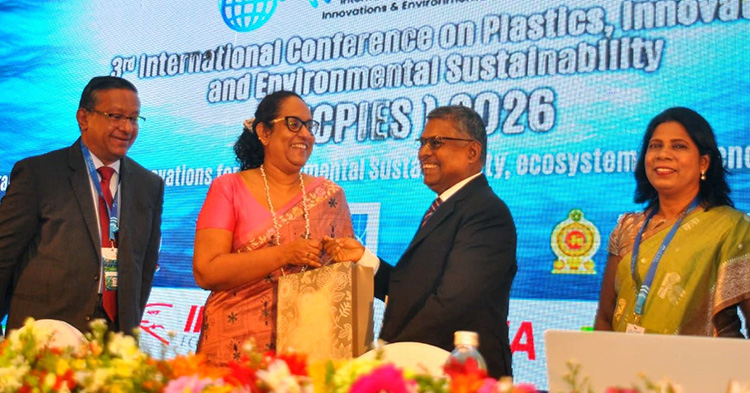
Sri Lanka’s plastic problem can no longer be treated simply as a waste-disposal issue, with the country facing mounting pressure on its coastal environment, fisheries, communities and public health, Vice Chancellor of The Open University of Sri Lanka Senior Professor P. M. C. Thilakerathne said.
The country must move beyond collecting and disposing of plastic waste and fundamentally rethink how plastics are designed, produced, consumed and recovered, Prof. Thilakerathne said, calling for a national shift towards a circular economy.
Addressing the 3rd International Conference on Plastics, Innovations and Environmental Sustainability, he said Sri Lanka’s experience, particularly the environmental fallout from the 2021 X-Press Pearl disaster, demonstrated why plastic pollution required urgent national attention.
The X-Press Pearl disaster resulted in large quantities of plastic pellets being released into Sri Lanka’s coastal waters, with impacts extending to marine biodiversity, fisheries and coastal livelihoods.
For an island nation whose economy and communities are closely connected to the sea, he said, plastic pollution could not be viewed as an environmental issue separate from national development.
” For Sri Lanka, these figures are not abstract,” Prof. Thilakerathne said, pointing to the global growth in plastic production and waste.
The world produces hundreds of millions of tonnes of plastics annually, while only a small proportion of plastic waste is recycled. A substantial amount ends up in landfills or is leaked, dumped or otherwise mismanaged.
The scale of the global problem has direct relevance to Sri Lanka, he said, because waste that is inadequately collected or managed can ultimately find its way into waterways and the ocean.
The Vice Chancellor said Sri Lanka therefore needed to strengthen not only waste collection and recycling but also the systems that determine what products enter the waste stream in the first place.
“Much of the waste problem is decided at the drawing board,” he said.
Products should be designed for reuse, recycling and disassembly, while businesses should be encouraged to adopt models based on refill, repair and reuse rather than continued dependence on single-use plastics.
He said Sri Lanka also had an opportunity to develop locally appropriate alternatives using renewable resources and agricultural residues.
The country’s coconut industry and other agricultural resources could support research into alternative materials, he said, but scientists must ensure that such substitutes were genuinely environmentally sustainable and did not simply shift the environmental burden elsewhere.
For Sri Lanka, the challenge is particularly important because plastic pollution intersects with several economic sectors.
Fishing communities depend directly on healthy marine ecosystems, while tourism depends heavily on the country’s beaches, coastal areas and natural environment.
Plastic pollution can therefore translate into economic and livelihood pressures in addition to its ecological consequences, Prof. Thilakerathne said.
He also warned that the problem extended beyond visible plastic waste.
Microplastics and nanoplastics have been detected in drinking water, food and air, while research into their potential effects on human health is continuing.
The longer-term public-health implications represented an important area for scientific research, he said.
Prof. Thilakerathne called for stronger cooperation between universities, government institutions, industry and local communities to develop solutions suited to Sri Lanka rather than relying solely on technologies or approaches developed elsewhere.
Universities, he said, had a responsibility to generate the evidence needed for national policy and to ensure that research reached the communities and industries expected to implement it.
This is where OUSL could make a particular contribution, given its nationwide network and large population of students, including working adults, teachers, professionals and learners from rural communities.
The university plans to strengthen environmental sustainability and circular-economy principles across its curriculum, expand professional education on waste management and sustainable materials, develop international research partnerships and improve sustainable practices within its own campuses and centres, he said.
Prof. Thilakerathne also called attention to the thousands of people who earn a living through informal waste collection and recycling.
Any national strategy, he said, must recognise the contribution of these workers and ensure that the transition towards a circular economy does not leave them economically vulnerable.
Sri Lanka has already introduced restrictions on a number of single-use plastic products, but the Vice Chancellor said regulations must be accompanied by enforcement, investment in recovery infrastructure, industry participation and changes in consumer behaviour.
At the international level, he said, Sri Lanka also needed to contribute actively to efforts to address plastic pollution, backed by credible national scientific research.
The global nature of the plastics trade and pollution meant that action by individual countries alone would not be sufficient.
The conference therefore provided an opportunity for Sri Lankan researchers to connect local environmental challenges with international research and technological developments, he said.
Addressing young researchers and students, Prof. Thilakerathne urged them to measure the value of their work not only by academic publications but also by its ability to produce practical change.
He encouraged researchers to work across disciplines, engage with policymakers and industry, and remain connected to communities affected by the problems they study.
“The most meaningful research is that which changes practice,” he said.
He said Sri Lanka’s plastic crisis ultimately required a change in the country’s approach to materials, consumption and waste.
“Our task is not to abandon the material that shaped the modern world but to make it compatible with the sustainable one,” Prof. Thilakerathne said.
Source: The Island