Sajith Premadasa Accuses Government of Introducing New Laws to Suppress Public Opposition
· Sri Lanka
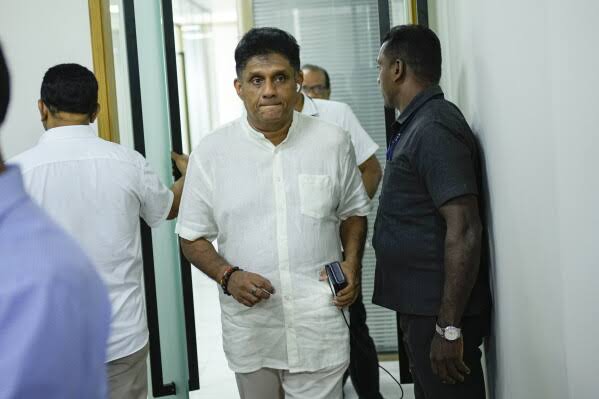
Opposition Leader Sajith Premadasa has accused the government of introducing two new pieces of legislation to protect itself from public criticism and opposition, rather than addressing the country's economic and development challenges.
He said the government had failed to deliver on its promises to reduce fuel and electricity prices, adding that fuel was still not available at the price prevailing when it was unloaded at the port. He also claimed that despite the promise to reduce electricity bills by 33 per cent, another electricity price increase could be expected in the coming days.
Addressing a Samagi Jana Balawegaya membership promotion programme in the Aralaganwila electorate of Polonnaruwa District, Premadasa alleged that the proposed legislation would give the Executive powers currently held by the judiciary and allow the government to define terrorism according to its own interpretation.
He claimed that the proposed laws could infringe on fundamental freedoms, including the rights to freedom of expression, discussion, opinion, political participation and peaceful protest. He also alleged that even clothing, hairstyles and tattoos could be treated as offences under the proposed provisions.
Premadasa further argued that the government was misleading the public by presenting the legislation as a measure to protect the state from terrorism, when, in his view, it was intended to protect the government from public opposition.
Religious affairs and respect for clergy
Commenting on religious affairs, the Opposition Leader said Buddhism had been given a special place under the Constitution in recognition of the country's Buddhist majority, while other religions and cultures were also entitled to their rightful place.
He recalled that former President Ranasinghe Premadasa had established a Cabinet-level Ministry of Buddha Sasana and separate State Ministries for other religious affairs. He claimed that this arrangement had since been abolished.
He also stressed the importance of respecting religious leaders and Buddhist monks, arguing that the government should have acted with greater sensitivity when implementing regulations affecting the Buddhist clergy.
Criticism over paddy prices and rice imports
Turning to the agricultural sector, Premadasa accused the government of failing to honour its election promise to establish a guaranteed price of Rs. 150 per kilogram for paddy.
He said the Agriculture Minister had stated in Parliament that the cost of producing a kilogram of paddy was Rs. 137, yet the government had set the guaranteed price at Rs. 120. He further claimed that some farmers were currently forced to sell their harvest for as little as Rs. 97 per kilogram.
Premadasa also criticised the government's rice import policy, recalling that its representatives had previously accused earlier administrations of importing rice to obtain commissions. He claimed that the current government had nevertheless imported a total of 340,000 metric tonnes of rice in two separate instances.
He called for a national agricultural plan to address the mismatch between rice production and consumer demand.
According to figures presented by Premadasa, Sri Lanka produces approximately 3.4 million metric tonnes of rice annually, while domestic demand stands at around 2.5 million metric tonnes. He said that even after allocating 500,000 metric tonnes for other products, a surplus of approximately 400,000 metric tonnes remained.
He also highlighted differences in consumer demand, stating that around 76 per cent of consumers prefer red and white Nadu rice, while Samba and Keeri Samba each account for approximately 12 per cent. He argued that cultivation patterns should be adjusted to match market demand.
Calls for modernising agriculture
Premadasa said Sri Lanka needed to modernise its agricultural sector through technology and improved farming practices.
He proposed that agricultural officers at the Grama Niladhari division level could help educate and train farmers in modern techniques.
Referring to the Netherlands, he said the country had become one of the world's leading agricultural exporters through technology-driven farming, despite a significant portion of its land being below sea level.
SJB's economic and political approach
Premadasa said the Samagi Jana Balawegaya followed a policy of humanitarian capitalism and social democracy rather than neoliberalism.
He added that the party, which had completed six years, aimed to protect all sections of society apart from the extremely wealthy.
He also presented figures to highlight the financial difficulties faced by farming families. Based on the figures he cited for white Nadu paddy cultivation, he estimated that a farmer cultivating one acre could earn approximately Rs. 66,528 over a six-month period if the harvest was sold at Rs. 120 per kilogram.
This, he said, would amount to a monthly profit of approximately Rs. 11,088, raising serious questions about whether a farming family could meet its living expenses on such an income.
Premadasa warned that without fair prices for their harvests, farmers would continue to face severe financial hardship and poverty.
Source: Serendib News