PM warns Sri Lanka’s waste crisis is a ‘disaster waiting to happen’
· Sri Lanka
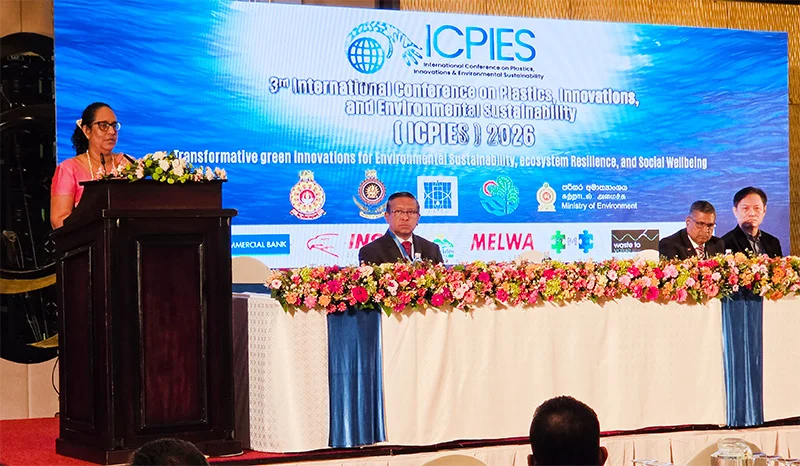
Prime Minister Dr. Harini Amarasuriya warned that Sri Lanka’s worsening waste-management crisis, particularly the uncontrolled accumulation of plastic waste and poorly managed landfills, was a “disaster waiting to happen”, urging scientists, researchers and policymakers to help the government find practical solutions before the problem reaches a critical point.
Addressing the launching of the Open University of Sri Lanka organized, ‘International Conference on Plastics, Innovations and Environmental Sustainability’ (ICPIES 2026) as Chief Guest, at the Cinnamon Lakeside Hotel yesterday she said waste management, waste reduction and recycling had become national priorities, with the government placing greater emphasis on the issue in its preparations for the 2027 Budget.
‘This is becoming a critical issue and something that, at any moment, if we don’t manage it properly, could become a huge disaster. It’s a disaster waiting to happen, Dr. Amarasuriya said.
She said unregulated and poorly managed landfills, particularly in and around Colombo, posed serious environmental and public risks, while increasing urbanisation was extending the waste-management challenge beyond the capital to other parts of the country.
‘As a member of Parliament for the Colombo District, I can tell you that one of the biggest challenges we are facing is waste management and actually managing the recycling of waste, and particularly of plastic products. This is something that we are battling every day, she said.
The Prime Minister said the government could not regard economic development as meaningful if it came at the expense of the country’s environment and natural resources.
‘If we are to speak of a beautiful life, we must first ensure that the air we breathe, the water we drink, the soil on which we live, the food we eat is clean and secure, she said.
She pointed to the scale of the global plastics crisis, noting that around 400 million tonnes of plastic waste are generated worldwide each year, while between 19 and 23 million metric tonnes of plastic waste enter natural ecosystems annually.
Plastic waste eventually breaks down into microplastics, which can enter aquatic organisms and subsequently the human food chain, she said.
Dr. Amarasuriya also linked plastic consumption and environmental degradation to the wider climate crisis, warning that the consequences of climate change were already being experienced by communities around the world.
She referred to devastating floods and landslides in the Himalayan region and said the impacts of climate change demonstrated that environmental damage could have consequences far beyond national boundaries.
Coastal clean-up projects and other waste-separation and recycling initiatives are also being implemented, while the government is working with the Western Provincial Council on a refuse-derived fuel project at Karadiyana.
The third ICPIES, held under the theme “Eco-Driven Innovations,” brings together researchers, policymakers, industry representatives and other stakeholders to examine plastic pollution, microplastics, circular-economy approaches, waste-management policy, technological innovation, artificial intelligence and smart environmental monitoring. The conference ends today.
Senior Professor P. M. C. Thilakarathne, Vice Chancellor of the Open University of Sri Lanka, was the Guest of Honour.
Source: The Island