Opposition alleges govt. move to arm military with police powers
· Sri Lanka
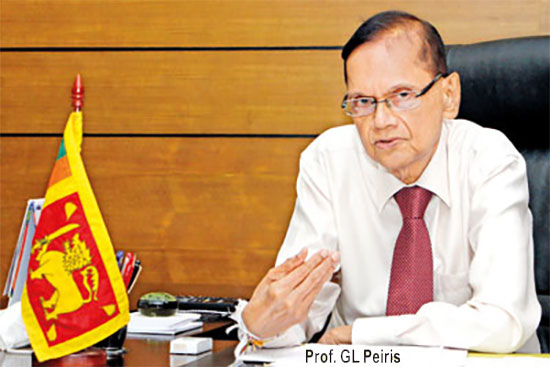
Former External Affairs Minister Prof. G. L. Peiris has warned that the NPP government plans to grant police powers to the armed forces and confer sweeping powers on the Secretary to the Ministry of Defence under the proposed Protection of the State from Terrorism Bill.
Addressing the media at former President Ranil Wickremesinghe’s office at Flower Road, Colombo, Prof. Peiris explained how the proposed legislation could be used to silence the democratic Opposition and suppress the media.
The former parliamentarian said the Bill posed a grave threat to civil liberties because it lacked a sufficiently clear definition of terrorism. Although the Opposition accepted the need to replace the Prevention of Terrorism Act (PTA), which has been in force since 1979, he stressed that the proposed legislation could criminalise legitimate political activities.
A person conducting a political campaign to pressure the government to abandon a project, or even distributing leaflets opposing a government initiative, could face terrorism charges, he warned.
Prof. Peiris also expressed concern over provisions empowering the Defence Secretary to issue detention orders and restrict access to certain places. He argued that these powers could be used to curtail the activities of the media and restrict people’s movements.
Questioning the need to authorise the armed forces to exercise police powers in the absence of a state of emergency, he warned that the provisions could undermine democratic practices and weaken judicial safeguards.
He also criticised provisions allowing suspects to be detained for extended periods under orders issued by the Defence Secretary. Under the proposed law, an initial detention order could be issued for up to two months, with the possibility of an extension, potentially exposing individuals to prolonged detention.
Prof. Peiris alleged that the government was creating an environment in which the Defence Secretary could authorise detention without adequate judicial oversight, paving the way for the suppression of democratic opposition.
The proposed Protection of the State from Terrorism Bill and the Prevention of Organised Crimes Bill have drawn criticism from political parties and civil society groups concerned about their implications for fundamental rights and civil liberties. (SF)
BASL demands comprehensive probe into latest death in police custody
Condemning the latest death in police custody, the Bar Association of Sri Lanka (BASL) yesterday (27) requested the Inspector General of Police, and all relevant authorities, to ensure an immediate, impartial, transparent and comprehensive investigation into the circumstances surrounding the death of Ishara Harshakumara,
The text of the statement: “BASL views with grave concern the death of 29-year-old Ishara Harshakumara, a resident of Kiriwaththuduwa and a father of two, while in the custody of the Homagama Police Station, following his arrest in connection with a drug-related investigation.
It has been reported that members of the family, who visited the Homagama Police Station on the morning of 25th October, 2026, to inquire about his condition, have expressed the view that they observed physical injuries which, in their opinion, indicated that he had been severely assaulted. In contrast, the Police Spokesman has stated that the suspect developed a sudden illness during an operation and died following hospital admission. In these circumstances, the BASL considers it imperative that the circumstances, surrounding the death, are fully and independently established, and that the differing accounts and concerns raised in relation thereto are subjected to a transparent and credible investigation.
The BASL emphasises that a death in custody is a matter of the gravest concern, and that the State has a fundamental and non-delegable duty to safeguard the life, health and bodily integrity of every person in its custody. Any allegation of custodial violence or ill-treatment must therefore be treated with the utmost seriousness and, if established, dealt with strictly in accordance with the law. Article 13(4) of the Constitution and the jurisprudence of the higher judiciary affirm that deprivation of life cannot be imposed as punishment except by order of a competent court, underscoring the obligation of law enforcement authorities to ensure that the rights and dignity of persons in custody are fully protected.
While noting that the Homagama Magistrate’s Court has ordered a post-mortem examination and that a preliminary inquiry has been initiated under the direction of the Homagama Assistant Superintendent of Police (ASP).
In a matter involving an allegation of custodial violence, public confidence requires that no reasonable question is left unanswered and that any person responsible for wrongdoing, if established, is held accountable in accordance with the law.
Accordingly, the BASL calls upon the Inspector General of Police and all relevant authorities to ensure an immediate, impartial, transparent and comprehensive investigation into the circumstances surrounding the death of Ishara Harshakumara, with all relevant evidence properly preserved and examined and the investigation conducted without interference or prejudice.
The BASL condemns any act of custodial violence or unlawful deprivation of life, if established through a proper investigation, while reiterating that the facts must be determined through a fair, independent and credible process. The BASL will take further steps if required in this regard and keep its membership and the general public informed.”
Sri Lanka’s electricity supply security has come under renewed scrutiny after a generating unit at the Norochcholai Lakvijaya coal power plant complex was taken offline for maintenance, just two days after all three units were reported to have returned to the national grid, following the October 17 countrywide blackout.
The latest shutdown of Unit 2, reported on October 26, has raised questions about maintenance planning, the reliability of the country’s largest coal-fired power station and the adequacy of public disclosures on the availability of critical generating capacity.
As of Tuesday (27), no confirmed date for Unit 2’s return to service was available in the reports reviewed. Nor had the authorities publicly explained the precise nature of the maintenance, whether it had been scheduled before the blackout or whether it was connected to inspections or remedial work following the incident.
The absence of a clear timeline is significant because the restoration of Unit 2 to its full 270-megawatt capacity, on October 22, enabled the National System Operator (NSO) to discontinue electricity demand-management measures imposed from October 19 to 21. The Unit 3 was subsequently reconnected, with all three units reportedly contributing to the grid by October 24.
The renewed shutdown, therefore, comes at a sensitive moment, when the power sector is attempting to restore confidence in the reliability of electricity generation following a countrywide system failure.
The sequence of events warrants a clear explanation from the authorities. A unit returning to full capacity and subsequently being taken offline for maintenance does not, by itself, establish a breakdown or negligence.
However, the public needs to know whether the work was planned, why it became necessary, at this particular time, and how long the country must operate without that generating capacity.
Critics have alleged that substandard coal shipments brought in since this government came to power led to breakdowns at Norochcholai.
The three Norochcholai units, each rated at 300 MW, have a combined installed capacity of 900 MW. At the operating output reported during the recent restoration, the loss of Unit 2’s 270 MW represents a substantial reduction in available generation from the plant.
The NSO has reportedly assured consumers that the latest maintenance will not interrupt electricity supplies. That assurance, however, needs to be considered alongside the system’s available reserves, demand levels, hydropower output and the availability of other generating plants.
All three Norochcholai units were disconnected from the national grid following the nationwide blackout on October 17, when instability in the electricity system resulted in a total system failure. The shutdown was described as a safety measure while the system was being stabilised.
On October 20, Cabinet Spokesperson Nalinda Jayatissa said Unit 1 remained offline following a technical failure associated with the blackout. He also said that Unit 1 had undergone maintenance from July 30 to September 30 and rejected allegations linking the incident to substandard coal.
The restoration process subsequently proceeded in stages. On October 22, the NSO announced that Unit 2 had reached its full 270 MW output, allowing demand-management measures to end. Unit 3 was then brought back to the grid, with all three units reported to be operating by October 24.
The latest maintenance shutdown has reopened questions about the distinction between units being reconnected after a system-wide event and their sustained availability under normal operating conditions.
Were the units subjected to comprehensive inspections before returning to service?
Was the maintenance now being undertaken on Unit 2 already scheduled, or did the need emerge during the restoration process? Have engineers identified any common technical issues requiring further attention?
These questions are particularly relevant because the plant plays a central role in meeting Sri Lanka’s baseload electricity demand.
The recurring difficulties associated with Norochcholai have financial as well as technical implications. When coal-fired generation becomes unavailable, the system operator may have to rely more heavily on other sources, including thermal plants using imported fuel, depending on prevailing system conditions.
Such substitution can increase generation costs and place additional pressure on the finances of the electricity sector. The actual cost of the latest shutdown, however, cannot be established without information on replacement generation, fuel consumption and the duration of the outage.
Norochcholai has also experienced repeated breakdowns and maintenance-related shutdowns over the years. Earlier reporting documented major overhauls being postponed amid power shortages and other constraints, raising concerns about the long-term consequences of deferred maintenance.
The current episode makes it important to establish whether the latest work forms part of a properly planned maintenance programme or reflects an issue that could have been identified and addressed earlier.
It would be premature to conclude that the latest shutdown is connected to the October 17 blackout.
The available information does not establish such a link. Equally, the authorities should not leave consumers to speculate about the reason for the shutdown or its expected duration.
The Public Utilities Commission of Sri Lanka has published a page containing communications relating to the October 17 total system failure, including a preliminary report submitted by the NSO on October 23. The findings and recommendations of the investigation, and the extent to which they address the generation and transmission failures, remain important to public understanding of the incident.
The immediate issue is the restoration deadline. Neither a confirmed completion date nor sufficient technical details about the current maintenance were available in the reports reviewed by this newspaper.
The NSO and plant management need to clarify the work being undertaken, whether the shutdown was scheduled in advance, the expected return-to-service date and the precautions being taken to prevent further disruption.
They should also disclose the present output of Units 1 and 3, the available reserve margin and the contingency arrangements should another major generating unit become unavailable.
For a country still rebuilding confidence after a nationwide blackout and several days of demand management, assurances that there will be no interruption to supply are important. But reliable public communication also requires specific information on generation availability, maintenance schedules and restoration deadlines.
The central question is not simply whether electricity can be supplied today. It is whether Sri Lanka’s power system can maintain a dependable supply without repeated emergency measures or costly recourse to alternative generation.
Norochcholai’s latest shutdown makes that a question the authorities need to answer with facts, a clear timeline and a credible account of the maintenance programme.
Deputy Solicitor General Janaka Bandara yesterday (27) informed the Colombo Magistrate’s Court that indictments had been filed, in respect of the Airbus case, before the Permanent Trial-at-Bar, against four persons, including SLPP MP Namal Rajapaksa.
On behalf of the Commission to Investigate Allegations of Bribery or Corruption (CIABOC) Bandara brought the matter to the notice of Colombo Chief Magistrate Asanga S. Bodaragama.
The court was told that the indictments consisted of 24 charges against the defendants. Bandara said that he expected yesterday to be the last date this particular case was taken up at the Colombo Chief Magistrate’s court.
SLPP National List MP Rajapaksa has been held in remand since 4 September this year over the Rs 100 mn bribery allegation pertaining to the 2013 procurement of 10 aircraft from Airbus company. The arrest was made following an affidavit provided by absconding businessman Nimal Perera that he paid Rs 100 mn in cash to Namal Rajapaksa after receiving the money from Airbus to facilitate the deal.
Search for truth and justice in mass graves
Contempt charge against IGP: Police to consult AG
CoPF Chair: USD 2.5 mn loss to be recovered through taxes
Lanka introduces sponsor-based ETA process for five countries
Chemmani archaeologists’ report questions clandestine grave claims
Court says no authority to order robe reinstatement for Gnanasara Thera
MJ and Herath throw weight behind cricket reforms
Source: The Island