Financing Sri Lanka’s post-IMF development
· Sri Lanka
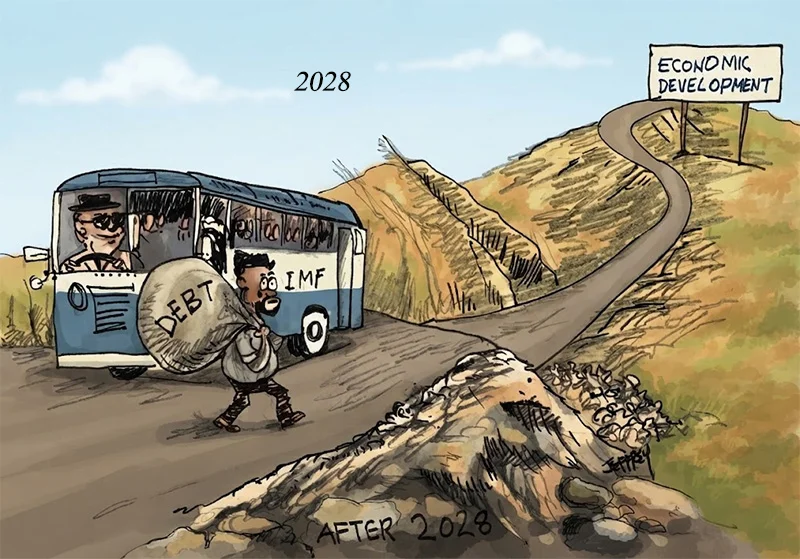
In March 2027, Sri Lanka’s Extended Fund Facility with the International Monetary Fund (IMF) will expire. It is the seventeenth arrangement the country has entered into with the Fund since 1965. That number is not a footnote; it is the argument. Sixteen previous left the underlying structure of the economy intact – an economy that imports what it consumes, exports what it cannot process further, and borrows to cover the difference. Each programme ended, and the conditions that produced it reassembled themselves.
The seventeenth has been the most invasive. Approved on 20 March 2023, in the aftermath of the sovereign default and the uprising that followed, it arrived at a moment of maximum leverage for the creditor and minimum room for the debtor. Fiscal consolidation was achieved primarily through indirect taxation, so that the burden fell heaviest on the poor. Energy subsidies were withdrawn and utility pricing made cost-reflective, transmitting global price movements directly into household budgets and industrial input costs. Public investment was compressed, and public sector wages held below inflation for years.
The revenue target was met but the social consequences are now well documented.
First, poverty in Sri Lanka roughly doubled after 2022 and has remained near a quarter of the population – a level not seen for two decades. Malnutrition among children, school dropout, and the depletion of household savings and assets are the transmission channels through which a fiscal adjustment becomes a lost generation.
Second, the most mobile and most skilled workers – nurses, doctors, engineers, IT workers – have left in numbers that constitute a structural loss of productive capacity, subsidised by the Sri Lankan state and captured by the labour markets of the Gulf, East Asia, and the West.
Third, and the least discussed, is the loss of economic sovereignty. The Central Bank Act of 2023 grants the Central Bank of Sri Lanka operational independence under a narrow inflation-targeting mandate and prohibits the monetary financing of government deficits, removing an instrument of development finance that every industrialised economy used on its way up. The Economic Transformation Act of 2024 legislates the programme’s own quantitative targets as binding statutory obligations on all future governments.
Although the IMF programme ends in March 2027, the framework it installed does not. Austerity has been converted into a legal architecture. Any government that wishes to finance development after 2027 will find that the fiscal space to do so has been pre-emptively legislated away, and that the debt service profile steps up sharply from 2028 as the restructured bonds begin to amortise in earnest.
Three instruments are currently under discussion for managing the debt portfolio. Each is worth examining on its merits, and each shares a common limitation.
The upside triggers are more likely to be hit than the underlying real economy warrants, because the reference variable is dollar GDP. A nominal appreciation of the rupee lifts dollar GDP without a single additional unit of output being produced. The control variable intended to guard against precisely this – a requirement of 11.5% cumulative real growth – is a low bar following two consecutive years of contraction, when the base effect alone does much of the work. The country may find itself paying creditors a growth premium for an exchange rate movement.
Debt-for-nature and debt for-climate arrangements can retire a portion of the stock and may unlock multilateral climate grants, which are concessional. But they do not address the productive structure that generates the deficit in the first place, and their conditionalities – conservation commitments over land, forest, and coastal zones – can cut directly against the industrial and energy build-out that any serious development strategy requires. A country cannot finance debt relief by constraining its own industrialisation.
Bond buybacks. Retiring restructured bonds converts a contingent, complex portfolio into a plainer one, which makes debt management tractable. If the bonds trade below face or recovery value, Sri Lanka retires debt at a discount. Lazard reportedly advised this course for Zambia, so the playbook exists. However, Sri Lankan bonds have performed strongly since the restructuring, which means the discount that would make a buyback attractive has largely disappeared. A buyback becomes cheap only if sentiment softens again, or if specific contingent tranches are marked down on fear of the upside triggers. Moreover, a sovereign buying back its own debt shortly after a restructuring invites the interpretation that it anticipates difficulty, which raises the cost of future issuance. Selective buybacks are worth pursuing, given the uncertain external environment and the value of a cleaner portfolio, but that they are a marginal improvement rather than a solution.
All three instruments manage the existing stock of debt. None of them generates new finance for development. They are exercises in liability management, and a country cannot manage its way out of underdevelopment. Sri Lanka needs relief and it needs capital, and the current conversation addresses only the first.
New financing without new institutions reproduces the crisis. Before Sri Lanka seeks capital abroad, it must rebuild the machinery that governs how it borrows.
The primary dealer system requires reconstruction on a proper legal footing. Before the crisis, the primary dealer network degenerated into a captive placement channel: when the central bank could no longer absorb unsold stock, dealers took paper on terms set by proximity rather than price. This is allocation by moral suasion, and it produced a domestic debt market that told the government nothing useful about the cost of its own borrowing. Rebuilding it with binding contractual obligations, genuine capital requirements, and published performance rankings – as China does for its own dealer network – would restore price discovery. A government that cannot read a true yield curve cannot manage a debt portfolio.
Sri Lanka also needs a published Medium-Term Debt Management Strategy (MTDS) with explicit targets for the composition of the portfolio: external against domestic, concessional against commercial, and fixed against floating rate. Borrowing at present is reactive, driven by immediate financing needs rather than by a strategic view of currency, rollover, and interest rate risk. An MTDS makes those trade-offs visible and accountable. It is unglamorous and it is prerequisite.
Sri Lanka’s most underused financial asset is its existing relationship with China’s monetary and capital market infrastructure. A currency swap line of 10 billion RMB is already in place, renewed in 2025, and it functions almost entirely as a passive reserve backstop. It could be the foundation of a financing strategy.
Broaden the use of RMB for trade settlement.
The swap is presently constrained in its permitted uses. Extending it to cover bilateral trade invoicing and settlement would reduce the dollar dependency that is the primary transmission channel for external volatility into the Sri Lankan economy. Every import invoiced in dollars is a claim on reserves that fluctuates with US monetary policy, over which Sri Lanka has no influence whatsoever.
Request eligibility for the FIMA RMB repo facility.
China’s facility, announced in June 2026, provides eligible central banks with access to RMB liquidity against holdings of Chinese government bonds. For Sri Lanka this would mean an RMB reserve buffer that is genuinely liquid rather than notional, and a second source of emergency liquidity that does not require a Fund programme as its precondition.
Issue panda bonds in the onshore Chinese market.
Sri Lanka has already begun refinancing dollar-denominated loans from Chinese banks into RMB, which establishes the precedent and the relationships. Issuance in the Shanghai interbank market would lock in RMB funding at rates below what the Eurobond market will offer a recently defaulted sovereign, and it diversifies the creditor base away from the Paris Club and Western commercial holders whose collective action in 2022 and 2023 was itself a lesson in concentration risk.
Access the offshore dim sum market in Hong Kong.
The offshore CNH market is deep – new issuance reached $157.2 billion in 2025 – and is a plausible source of medium-term infrastructure financing on terms that do not carry policy conditionality.
None of the above scales without payments infrastructure. Integration with China’s Cross-Border Interbank Payment System reduces exposure to dollar-clearing volatility, carries lower transaction costs than routing through SWIFT correspondent banking, and is what allows the swap facilities to be used at volume rather than symbolically.
Building on the Indonesia–HKMA–PBoC framework of June 2026, a direct settlement mechanism for bilateral trade would give Sri Lanka a working channel into one of the largest markets in the world, and create a pipeline for foreign direct investment and other inflows that does not transit the dollar system at all.
What Sri Lanka should build is a blueprint for a local currency settlement corridor that can be scaled to any partner. Begin with China, where the infrastructure already exists, and extend it to India, the country’s nearest neighbour and one of its largest trading partners, where rupee settlement arrangements are already operating with other states. The same institutional template – bilateral swap, direct settlement mechanism, payments system linkage, local currency invoicing – applies to any counterparty with which Sri Lanka has meaningful two-way trade.
The immediate prize is energy. A large share of Sri Lankan inflation originates in oil, transmitted through both the world price and the exchange rate at which it is paid. That volatility does not merely raise the cost of living; it creates genuine industrial hurdles, because manufacturers cannot plan around input costs that move with a currency they do not earn. Denominating energy imports in local currency terms would break one of the most damaging transmission channels between external shocks and domestic prices. For a country whose recent history is defined by a fuel queue, this is not an abstraction.
Multipolarity, understood correctly, is a portfolio strategy. A sovereign with settlement channels in several currencies, funding relationships across several capital markets, and reserve buffers denominated in more than one unit of account is a sovereign with options during a crisis. Sri Lanka in 2022 had none, and the terms it accepted in 2023 reflect that.
Source: The Island