Amnesty urges Saudi Arabia to overturn death sentence against Sri Lankan migrant worker
· Sri Lanka
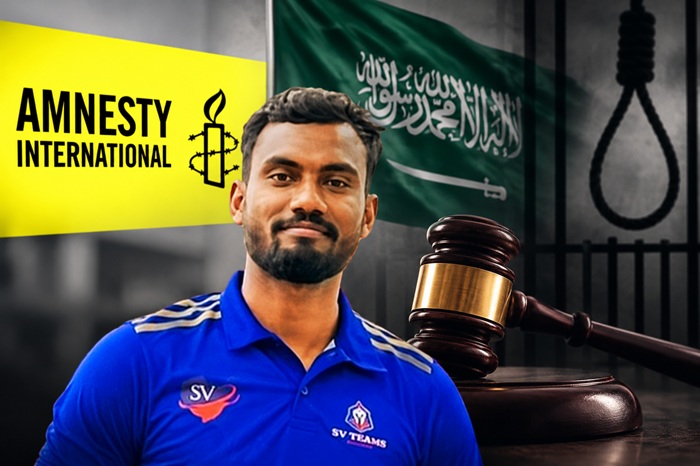
Amnesty International has urged Saudi Arabian authorities to immediately overturn the death sentence imposed on 24-year-old Sri Lankan migrant worker Anojan Sivarasa, who was convicted on blasphemy charges over a Facebook comment.
In a statement, the human rights organisation called for Sivarasa’s immediate and unconditional release, arguing that the charges against him stem entirely from exercising his right to freedom of expression.
According to Amnesty International, Sivarasa was arrested on July 1, 2026, after posting a Facebook comment deemed insulting to Prophet Mohammad.
He reportedly told the judge that he had made the comment in a moment of anger, subsequently deleted it and published a video apology expressing remorse.
On July 27, Sivarasa was initially sentenced to five years in prison and fined SAR 3 million. However, the sentence was increased to the death penalty following an appeal on September 17, less than two months later.
Amnesty International also alleged that Sivarasa was denied access to a lawyer from the time of his arrest until his initial sentencing.
Commenting on the case, Amnesty International’s Regional Director for the Middle East and North Africa, Heba Morayef, raised serious concerns over the application of the death penalty and the Saudi criminal justice system.
She stressed that no individual should face imprisonment or execution merely for expressing views, even if they are considered offensive or insulting.
Morayef further warned that Sivarasa’s execution would amount to an arbitrary deprivation of life and called on Saudi authorities to overturn his conviction and release him immediately.
Amnesty International also highlighted that international human rights law restricts the death penalty to the most serious crimes, understood to involve intentional killing.
The organisation urged Saudi Arabia to establish a moratorium on executions as a first step towards the complete abolition of the death penalty.
Saudi Arabia remains one of the world’s leading executioners. As of 5 October 2026, at least 175 people had been executed in Saudi Arabia this year, including many for drug-related offences. Foreign nationals account for a majority of those executed, with at least 94 foreign nationals from more than 20 countries put to death this year alone.
Saudi Arabia’s courts have, in recent years, imposed prison sentences of up to several decades for social media posts, with sentences swinging widely on appeal.
Saudi Arabia has no written penal code: many offences and their punishments are not defined in law but left to the discretion of judges, who rule according to their own interpretation of Sharia. Where written laws do exist, the authorities often rely on vague and overly broad provisions of the counter-terror law and anti-cybercrime law, such as impinging on “public order”, “religious values”, and “public morals,” to criminalize people solely based on their exercise of the right to freedom of expression.
“Saudi authorities must halt this crackdown on freedom of expression and immediately release all those detained solely on the basis of their exercise of human rights,” said Heba Morayef.
On 27 July, the Criminal Court in Al Ahsa sentenced Anojan Sivarasa to five years’ imprisonment and a SAR 3 million fine, the maximum punishment under Article 6 of the Anti-Cybercrime Law. On 17 September, the Court of Appeal in the Eastern Region increased his sentence to death as a hadd punishment, which is a fixed, mandatory punishment under Sharia. Anojan has appealed the death sentence.
Amnesty International opposes the death penalty in all cases without exception regardless of the nature or circumstances of the crime; guilt, innocence or other characteristics of the individual; or the method used by the state to carry out the execution.
Source: Newswire LK